
Lumpkin County Superior Court
Lumpkin County Superior Court sits in the Enotah Judicial Circuit. Georgia's court structure places Superior Court as the general trial court with broad civil and criminal jurisdiction. Georgia.gov states that Superior Court handles civil and criminal law actions and has exclusive jurisdiction over divorce, title to land, equity matters, and felony jury trials. In Lumpkin County, the Clerk of Superior Court is the record custodian for Superior Court case files and also serves Juvenile and Magistrate record custody functions identified in the research.
The assigned source image comes from O.C.G.A. 15-10-2, which describes Magistrate Court jurisdiction for warrants, civil claims, and dispossessory proceedings.
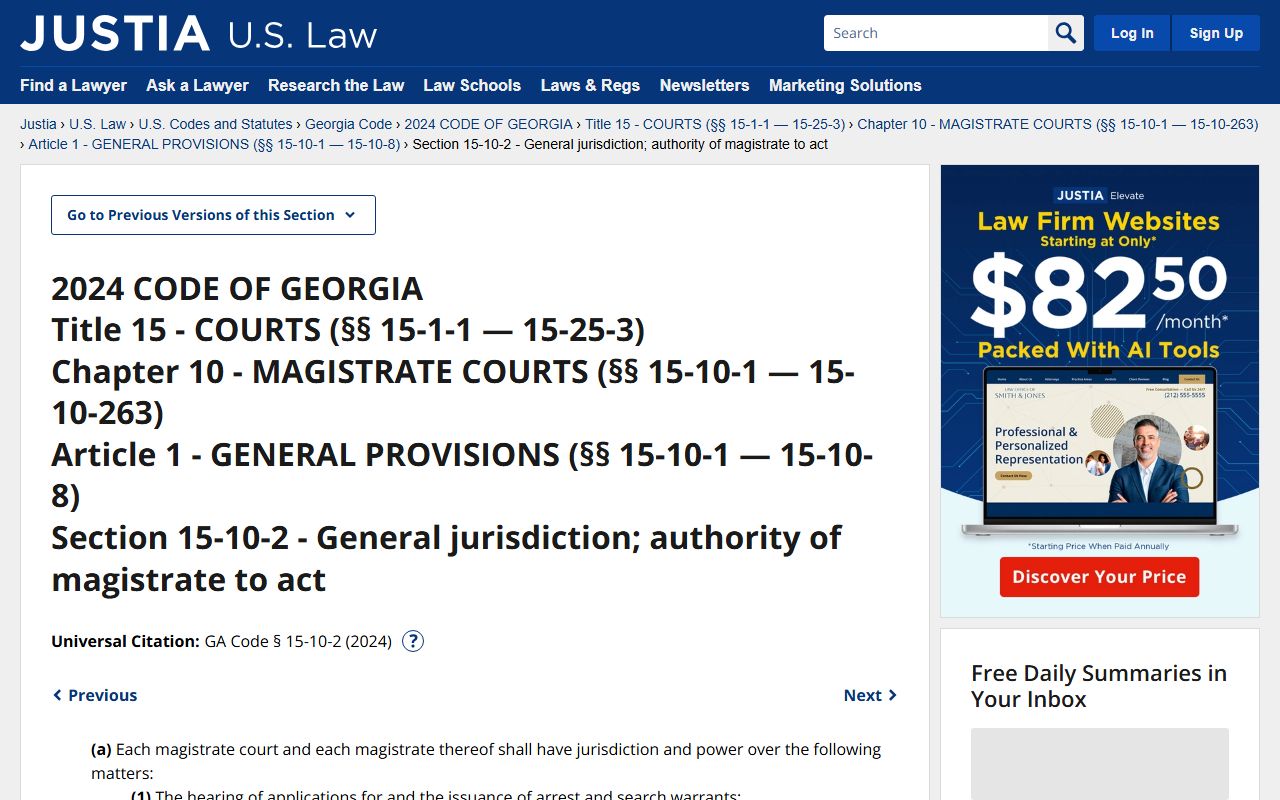
The statute source documents lower-court jurisdiction under Georgia law, which matters because many Lumpkin County cases begin in Magistrate Court before a Superior Court case file or appeal path exists.
Lumpkin County Superior Court List
Lumpkin County does not have numbered trial courts under Georgia's local court structure. The researched court table points to the Superior Court in the Enotah Judicial Circuit, with related local courts and offices at the Justice Center. Superior Court judges and juvenile court personnel appear in the Enotah Judicial Circuit contact sheet, while case-copy requests generally route through the Clerk of Superior Court.
| Court or Office | Type | Address | Phone |
|---|---|---|---|
| Lumpkin County Superior Court / Enotah Judicial Circuit | General jurisdiction trial court | 325 Riley Road, Dahlonega, GA 30533; judge rooms vary | Clerk 706-864-3736 |
| Clerk of Superior Court | Superior, Juvenile, Magistrate, land, and property record custodian | 325 Riley Road, Room 108, Dahlonega, GA 30533 | 706-864-3736 |
| Magistrate Court | Warrants, small civil claims, dispossessory, process, ordinance, and certain misdemeanor matters | 325 Riley Road, Room 109, Dahlonega, GA 30533 | Criminal 706-864-7760; Civil 706-864-3736 |
| Probate Court | Estates, wills, guardianships, marriage, vital records, carry licenses, and Probate traffic | 325 Riley Road, Room 122, Dahlonega, GA 30533 | 706-864-3847 |
| Juvenile Court | Juvenile matters in the Enotah Circuit | 325 Riley Road, Room 223, Dahlonega, GA 30533 | 706-864-8770 per 2024 circuit PDF |
| District Attorney | Criminal prosecution for Enotah Circuit matters | 325 Riley Road, Room 226, Dahlonega, GA 30533 | 706-864-6754 |
| Dahlonega Municipal Court | City traffic, ordinance, and general misdemeanor cases | Dahlonega City Hall, 465 Riley Road, Dahlonega, GA 30533 | 706-864-6133 |
Superior Court vs Lower Courts
Georgia's local trial structure is split by jurisdiction rather than by one all-purpose court. A felony, divorce, title-to-land, or equity matter belongs in Superior Court. A dispossessory case, warrant application, small civil claim, or county ordinance matter may begin in Magistrate Court. Estates, marriage, vital records, and Probate traffic belong in Probate Court. City traffic or city ordinance cases are separate through Dahlonega Municipal Court.
| Feature | Superior Court | Magistrate Court | Probate Court | Municipal Court |
|---|---|---|---|---|
| Main role | General trial jurisdiction | Limited civil, warrant, process, and certain misdemeanor functions | Estates, wills, guardianships, vital records, marriage, carry licenses, Probate traffic | City traffic, ordinance, and general misdemeanor cases |
| Civil scope | Major civil, equity, title to land, domestic relations | Civil claims up to $15,000 where not assigned elsewhere | Estate and guardianship matters | City-code matters |
| Criminal scope | Felonies and related criminal case files | Warrant applications, first steps, county ordinance, and certain misdemeanors | Traffic citations assigned to Probate Court | City misdemeanors and traffic |
| Record contact | Clerk of Superior Court | Magistrate Court or Clerk, depending on record | Probate Court | Dahlonega Municipal Court |
Lumpkin County Case Flow
A criminal case may start with a Sheriff's Office arrest or Magistrate warrant function, then move to prosecution review, Superior Court filing, arraignment, motions, plea or trial, disposition, sentence, and appeal. A civil case may start with a complaint or petition at the Clerk's office, followed by answer, motions, hearings, order, judgment, post-judgment steps, and appeal. Probate and Municipal matters follow their own court channels unless an appeal or related case reaches Superior Court.
Criminal flow: Arrest or warrant › Magistrate first steps › District Attorney review › Superior Court filing › Arraignment › Pretrial › Plea or trial › Sentence › Appeal.
Civil flow: Complaint or petition › Clerk filing › service › answer › motions or hearing › order or judgment › post-judgment or appeal.
Lumpkin County Superior Jurisdiction
O.C.G.A. 15-6-8 describes Superior Court jurisdiction and powers. The Georgia court guide and Georgia.gov materials place Superior Courts above limited-jurisdiction courts for broad civil and criminal matters. In Lumpkin County, this means Superior Court is the forum for felony jury-trial authority, divorce, title-to-land cases, equity matters, major civil cases, and appeals from lower courts where Georgia law provides that route.
Superior Court records can include complaints, answers, motions, orders, judgments, indictments or accusations, pleas, sentencing orders, bond orders, final divorce decrees, post-judgment papers, appeal entries, and other docket events. Case search access may start online through Georgia Courts e-access and PeachCourt for Lumpkin Superior, but certified records and non-digitized files remain a Clerk of Superior Court function.
Enotah Judicial Circuit
Lumpkin County Superior Court is part of the Enotah Judicial Circuit rather than a stand-alone county-only bench. The circuit contact sheet identified Superior Court judges Joy R. Parks, T. Buckley Levins, and Raymond E. George, with Lumpkin address listings and related court personnel. The circuit also includes District Attorney, public defender, probation, Department of Community Supervision, juvenile, and other justice contacts.
The circuit structure affects how users should read local court records. A judge, prosecutor, or public defender may serve multiple counties in the circuit, while the court file and certified copies for a Lumpkin County case still route through the Lumpkin County Clerk of Superior Court. Weather closures, judicial emergencies, and specialty-court programs may also be circuit-level, as shown by the 2024 Hurricane Helene judicial emergency reference in the research.
Search Lumpkin Superior Court Records
Lumpkin Superior appears on the Georgia Courts e-access directory as a PeachCourt court. The research found that Georgia Courts redirects users to provider websites and that provider account access is expected before full searching or document viewing. The public PeachCourt page describes civil and criminal e-filing and court documents across Georgia, but public static capture did not expose case-search fields without login.
- Use the Georgia Courts e-access directory and select or locate Lumpkin Superior.
- Proceed to PeachCourt and expect account registration or login before full case access.
- For certified copies, older files, or non-digitized records, call the Clerk of Superior Court at 706-864-3736.
- For Magistrate, Probate, or Dahlonega Municipal matters, use that court's office instead of assuming Superior Court has the first file.
- For federal cases, use PACER and the Northern District of Georgia, not the Lumpkin County Clerk.
Note: Juvenile and adoption records may appear in Clerk custody, but access can require party status, attorney access, or a court order.